
 Français
Maurice Sagna (Dakar 1983 – Dakar 2026)
2026 Jul 06
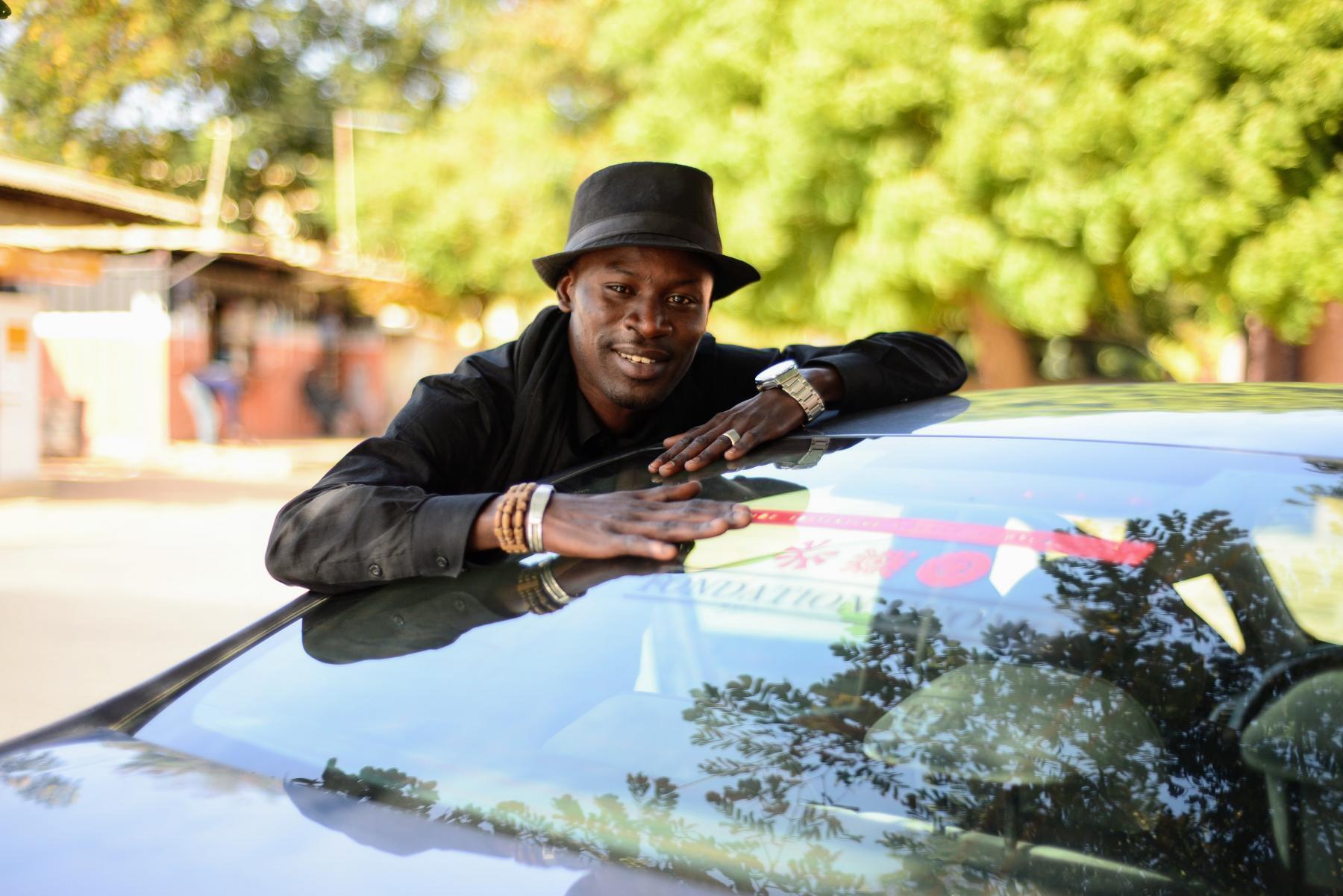
“One summer’s day in 2015, on the construction site of a children’s health centre in Dakar, Maurice Sagna crossed paths with Maria Elena Cuomo. […] The President of the Cuomo Foundation was moved by the young man’s story and by his dreams, which, like the waves breaking against the reefs of the Almadies headland, kept crashing up against reality.
[…] Today, a year on, Maurice is rich in determination. He drives his clients from one end of the capital to the other, through a city he knows by heart, having roamed it throughout his youth. In the evening, he brings his car back to the office — Authentik Business — in the heart of Sacré-Cœur, Dakar’s burgeoning business district. The small premises, decorated to his own taste, are the young entrepreneur’s pride and joy.”
Full of hope for Maurice, and conscious of the privilege of having accompanied him on his path towards a less precarious life, we wrote those lines in February 2017.
That was nine years ago ; another age altogether. Maurice is gone.
How can one begin to imagine such a thing? How, above all, can one accept it? Did the reefs of the Almadies headland, in the end, get the better of his dreams? Did the struggle to carve out a path through an unforgiving world finally claim his life?
Born in 1983 in a working-class housing estate, and fatherless from an early age, Maurice never knew the carefree years to which every child should be entitled. After a patchy schooling, he was thrown into the deep end of life too soon and, inevitably, ill-equipped.
Yet the young man was hardworking, courageous, and driven by an iron will. That was his greatest strength. He was irresistibly drawn to mechanics. Anything on wheels fascinated him; anything that roared intoxicated him. He would have loved to become a racing driver. Pragmatic by nature, he sought instead to turn that passion into a trade, and began working towards a vocational certificate in car mechanics.
In 2009, certificate in hand, he began his working life — though not immediately in his chosen field, as life rarely allows, but as a cleaner at the Hôtel des Almadies in Dakar.
In the evenings, after work, the young man would let his mind wander. Sitting on the hotel steps, facing the Almadies lighthouse rising from the vast blue like a tiny hope in an adult world whose harshness he had yet to fully grasp, Maurice dreamed of a better life.
His spell at the hotel lasted only a year. Maurice was not in his element there. He would try his luck elsewhere. While waiting for fortune to smile, and in order to build up a small nest egg from which to launch the projects that truly mattered to him, he moved from one job to the next: labourer at the Sahel Cement Works, employee in vehicle brokerage, unskilled odd jobs in other hotels, before eventually finding work as a hire-car driver. There, at last, he found a job which, though it did not quite match his ambitions, at least belonged to the field he longed to enter. He had never been able to afford a vehicle of his own, whether on two wheels or four, but driving was his passion.
Like someone stepping cautiously onto a long-dreamed-of continent, Maurice finally entered the world of automobiles.
2015. A new construction site was taking shape in Dakar’s Fann district, in the heart of the capital’s national university hospital. A private European foundation was funding the project: a cardiac unit dedicated in particular to the care of children with heart disease — a first not only in this vast country, but across the whole of West Africa. Architects, engineers, designers and doctors came and went on site. The teams needed a driver. And so, for several months, Maurice worked almost exclusively for the project.
Then came the visit of Maria Elena Cuomo, President of the organisation behind the project, for the official foundation-stone ceremony, attended by the great and the good of Dakar, the First Lady among them.
Maria Elena Cuomo needed a driver for her journeys during her stay in the Senegalese capital, and the hospital teams recommended Maurice without hesitation. Affable, punctual, obliging, with a sure turn of phrase touched by a hint of flair, the knowledgeable young driver was the ideal candidate.
The President of the Cuomo Foundation was immediately charmed by his personality. Over the course of a busy week of official appearances, receptions and the signing of agreements, Maurice also proved an exceptional guide, a true ambassador for his native city: endless anecdotes, countless useful addresses. Between journeys, amid practical advice and information, Maurice also spoke to her of his life, his circumstances and his dreams. He wanted to set up a car-hire agency. He sometimes thought of Europe too; but he would rather have helped his own city develop from within.
On her return to Monaco, Maria Elena Cuomo found a project proposal on her desk: the creation of a small business hiring out chauffeur-driven tourist cars. The file was coherent, the market study well documented, the figures as reasonable as they were realistic. A helping hand might be lent to the young man's chaotic fortunes.
A few months later, the President returned to Dakar. The construction site was in full swing: concrete was being poured, cranes were rising; future staff were leaving for training in Vietnam, medical equipment was being studied, administrative formalities were becoming clearer. There was no shortage of assignments. From then until the official inauguration of the Centre Cardio-Pédiatrique Cuomo in 2019, it was in his own car that the young entrepreneur drove the President of the Cuomo Foundation on each of her visits.
Rarely had Dakar seen a happier driver take to its roads. Behind the wheel of his grey Peugeot, in that impeccable cabin where, depending on the day, alpine scents or Provençal fragrances lingered, the young man reigned over a kingdom behind tinted windows. His eyes sparkled with dreams, which he shared freely with his passengers, comfortably seated in the back, mints and bottles of water close at hand.
2020. Like so many projects, and so many lives, the small business that had only just taken flight did not survive the pandemic. Maurice first had to give up his premises, the agency he had fitted out with such care, its white walls covered in stickers bearing the logo he had designed himself. He, who had been planning to acquire a second car, found himself forced to part with the first, the only one he had.
He never recovered. With no prospects in sight, the money from the sale was never reinvested; it merely kept him going for a while. To his financial difficulties were added health complications. Maurice had always been frail. The care he had received in childhood, not always timely and not always suited to his needs, had left after-effects which, at regular intervals, returned to darken his days.
In recent years, news of him had grown scarce, passed on through mutual acquaintances. The last of it brought word of his death, from respiratory complications.
Maurice leaves behind the memory of an innocent soul, in the truest sense of the word: one incapable of doing harm; a fragile being delivered into a merciless world. Buffeted by life, he traced an uneven path, but one crossed by a few moments of brightness; the Foundation had the privilege of kindling some of them. On this day of Maurice’s funeral, we shall hold on to that meagre consolation. And to the duty his life leaves us with: to stand, each day, alongside the most vulnerable.
— Monaco, 6 July 2026